



Unify Governance, Risk, and Compliance Into One System
Modern organizations face growing regulatory demands, evolving risks, and increasing governance expectations. We help businesses eliminate silos by building integrated Governance, Risk, and Compliance (GRC) frameworks that connect policies, controls, risks, audits, and compliance activities into a single, manageable system. The result is greater visibility, stronger oversight, and better decision-making across the enterprise.

Most Organizations Struggle With Fragmented Compliance Systems
As organizations grow, governance, risk, and compliance activities often become disconnected across departments, tools, and processes. This creates inefficiencies, increases compliance costs, and limits visibility into enterprise risk exposure.
Disconnected Processes
Governance, risk, compliance, and audit functions operate independently without coordination.
Manual Compliance Tracking
Organizations rely on spreadsheets and manual processes that consume time and reduce visibility.
Audit Challenges
Preparing for audits becomes difficult due to scattered evidence and inconsistent documentation.
Poor Risk-Control Mapping
Controls are not clearly linked to risks, creating gaps in oversight and accountability.
Limited Executive Visibility
Leadership lacks a centralized view of compliance status, risk exposure, and governance performance.
Inefficient Reporting
Generating regulatory, management, and audit reports requires excessive manual effort.
We Build Integrated GRC Frameworks for Full Enterprise Control
Governance, Risk, and Compliance should function as a connected ecosystem rather than separate activities. We help organizations design and implement GRC frameworks that improve visibility, automate workflows, and strengthen enterprise governance.
GRC Framework Design
We establish structured governance models, risk management processes, compliance frameworks, and accountability structures aligned with business objectives.
Policy & Compliance Management
We help organizations centralize policies, standards, regulatory requirements, and compliance obligations within a structured governance framework.
Risk & Control Alignment
We map risks to controls, ensuring mitigation activities are measurable, monitored, and aligned with enterprise risk objectives.
Automation & Platform Integration
We implement GRC technologies and workflow automation that improve reporting, monitoring, compliance management, and audit readiness.
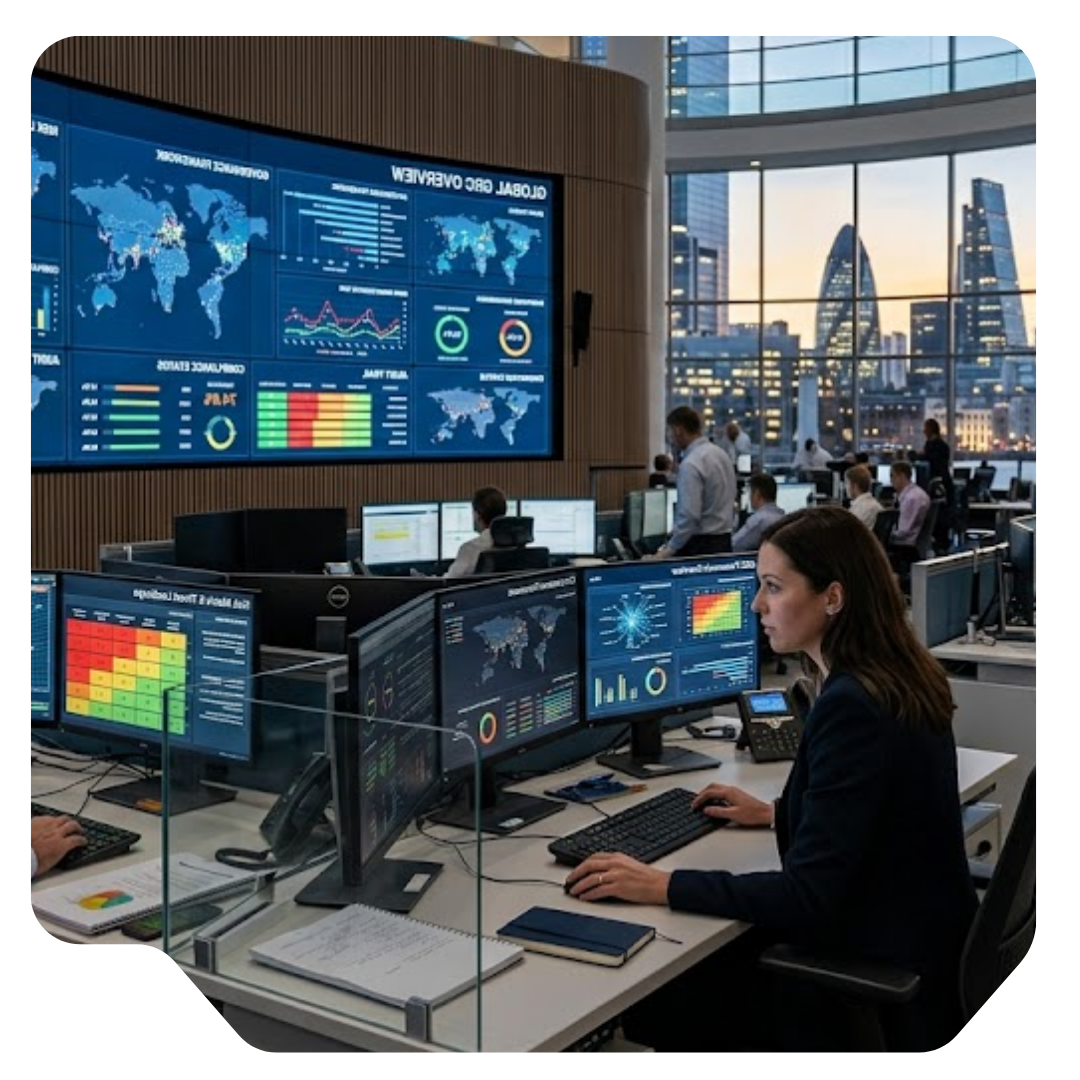
Built for Governance, Visibility, and Control
Unified Governance Visibility
Gain a centralized view of governance activities, compliance obligations, controls, and enterprise risks.
Reduced Compliance Effort
Streamline compliance management processes through automation and standardized workflows.
Better Audit Outcomes
Improve audit readiness with centralized documentation, reporting, and evidence management.
Stronger Risk Alignment
Ensure governance decisions, compliance requirements, and risk management activities work together effectively.
Built for Real Business Scenarios
Regulatory Compliance Programs
Manage compliance obligations across multiple regulations, standards, and jurisdictions.
Enterprise Risk & Governance Initiatives
Align governance structures with risk management and business objectives.
Digital Compliance Transformation
Replace manual compliance processes with automated workflows and centralized oversight.
Audit & Control Optimization
Improve control effectiveness, audit readiness, and governance performance across the organization.
Turn Governance Into a Business Enabler
Organizations with mature GRC capabilities operate more efficiently, manage risks proactively, and respond to regulatory requirements with confidence. Our GRC services help transform governance from a compliance burden into a strategic business capability.
Improved Risk Visibility
Understand enterprise-wide risks, control effectiveness, and compliance performance from a single view.
Stronger Governance Oversight
Enable leadership to make informed decisions through accurate reporting and structured governance processes.
Greater Operational Efficiency
Reduce duplication, manual effort, and administrative overhead through integrated workflows.
Sustainable Compliance Management
Build scalable compliance programs that adapt to evolving regulatory and business requirements.
Let's Build a GRC Framework That Strengthens Your Organization
Don't let disconnected processes create compliance gaps, governance challenges, and unnecessary risk.
Build an integrated Governance, Risk, and Compliance framework that improves visibility, strengthens accountability, and supports confident decision-making.
Frequently Asked Questions
What is Governance, Risk & Compliance (GRC)?
GRC is a structured approach that integrates governance, risk management, compliance, and control activities into a unified framework that supports business objectives and regulatory requirements.
Why is GRC important?
GRC helps organizations improve visibility, strengthen governance, manage risks proactively, reduce compliance costs, and improve operational efficiency.
What does a GRC framework include?
A GRC framework typically includes governance structures, policies, risk management processes, compliance obligations, controls, audits, reporting mechanisms, and performance monitoring.
How does GRC improve compliance management?
GRC centralizes compliance activities, automates workflows, improves reporting, and provides better visibility into compliance obligations and regulatory requirements.
Can GRC integrate with existing systems?
Yes. We support integration with enterprise GRC platforms, ERP systems, compliance tools, risk management solutions, and audit management systems.
Which standards and regulations can GRC support?
GRC frameworks can support ISO standards, industry regulations, cybersecurity frameworks, financial regulations, privacy requirements, and internal governance obligations.
Is GRC suitable for organizations of all sizes?
Yes. GRC frameworks can be scaled to meet the needs of large enterprises, government organizations, regulated industries, and growing businesses.
How long does a GRC implementation take?
Implementation timelines vary depending on organizational complexity, existing processes, regulatory requirements, and technology integration needs. Most organizations adopt a phased implementation approach for sustainable results.